
Two Objects That Both Hold Wine, Built Around Opposite Ideas
A wine cabinet and a wine cellar solve the same physics with opposite economics. The cabinet is a sealed box you buy; the cellar is a room you build. Most buyers stand between them with a collection that does not obviously belong to either, which is why this comparison is written as a table first and a recommendation never — the table gives you the trade-offs, and three questions at the end tell you which trade is yours.
The Table
| Wine Cabinet | Wine Cellar (conditioned room) | |
|---|---|---|
| What it physically is | Factory-sealed appliance, 20–300 bottles typically | Insulated room with a dedicated cooling system, hundreds to tens of thousands of bottles |
| Temperature control | Factory-set range, often two zones; nothing to adjust | One setpoint (about 13°C) set for keeping, tuned to the room’s measured behavior |
| Installation | Plug in; needs ventilation clearance | Construction project: vapor barrier, insulation, sealed door, condensate drain |
| Cost shape | Small up front, fixed, known at purchase | Larger up front, variable with room condition; cheaper per bottle at scale |
| Failure mode | Single sealed system; a failure takes everything inside offline | Split components; a cooling failure is usually repairable without moving the wine |
| Growth path | Buy another cabinet | Extend the racking inside the same conditioned envelope |
| Where it lives | Kitchen, dining room, living space | Basement, garage conversion, purpose-built room |
| Serving vs keeping | Excellent at serving temperatures (7–18°C by zone) | Excellent at keeping temperature (about 13°C); serving happens elsewhere |
Two rows deserve interpretation, because they decide most real choices — and a third number completes them: the growth row hiding inside the cost row. Cabinet growth is duplication, which means the second cabinet is roughly as expensive as the first, so cost per bottle barely falls as the collection doubles. Cellar growth is racking, which is the cheapest component in the stack, so the same room that cost heavily to build gets cheaper per bottle every year the collection grows. Run that curve five years out and the crossover point is where the honest decision lives — and it is a number you can compute for your own collection before anyone quotes anything.
The cost row is a per-bottle argument
A cabinet’s cost per bottle falls slowly — a 12-bottle unit and a 120-bottle unit cost nowhere near twelve times apart, but the 120-bottle price is still a multiple. A cellar’s cost is dominated by construction that barely cares whether it holds 800 or 3,000 bottles: the vapor barrier, insulation, door, and cooling system are roughly fixed against the room’s volume, and racking is the only part that scales with bottles. Past a few hundred bottles, the cellar wins the per-bottle arithmetic convincingly. Below that, the cabinet wins, because a room built for 150 bottles spends most of its cost on the envelope, not the wine.
The failure row is an insurance argument
A cabinet is one sealed refrigeration circuit. When it fails, the wine inside warms with the room, and the repair means service or replacement — days to weeks. A cellar usually runs a cooling unit whose failure does not endanger the room immediately: a well-insulated cellar drifts slowly, buying days to arrange repair, and a split system can be serviced without emptying the room. For a collection of drinking wine this distinction is trivial; for bottles being held for a decade it is the whole reason the cellar exists as a category.
The Third Idea: Display Storage
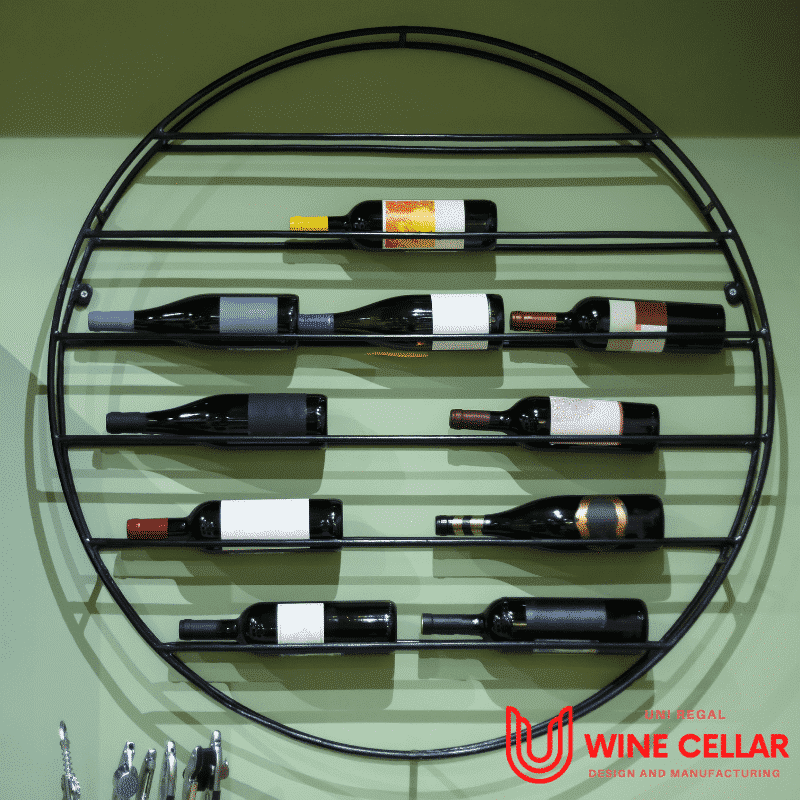
Between the two sits a third object worth naming, because it is often mistaken for either: display storage. Angled shelves that present labels, show shelving in dining rooms and retail spaces — built to be looked at first and to keep wine at service temperature second. It borrows the cabinet’s technology and the cellar’s ambition for beauty. It is the right choice when the wine is inventory to be sold or served within weeks, and the wrong choice for anything being kept — angle, light exposure, and constant door openings all work against long storage.
How to Select: Three Questions
Question 1: What does the collection do?
Wine you drink within a year belongs in a cabinet at service temperature. Wine you keep for five to twenty years belongs in a cellar at about 13°C. Collections that do both belong in both — and this is not a compromise answer; the two-object solution is cheaper and safer than asking one object to do two jobs, because the cabinet’s constant door openings are exactly what a keeping cellar must not have.
Question 2: What does the building allow?
A cellar needs a room whose temperature behavior can be controlled: a basement with steady earth temperature is the classic candidate, and the measurement that matters is the seasonal swing, not the average. A basement that swings 8 degrees across the year needs an insulated enclosure regardless of which object goes inside — and once the enclosure is built, the cellar argument is mostly won. A house with no suitable room pushes everything toward cabinets, and that is a correct answer, not a defeat.
Question 3: What happens in year five?
Cabinets grow by duplication — same model, another spot on the wall — which is simple and finite. Cellars grow by racking, which means the original design should be drawn with the unbuilt bays in it. If you cannot answer “where does the next hundred bottles go,” you are not choosing between cabinet and cellar; you are choosing between two cabinet purchases and one cellar purchase, and the arithmetic of that comparison is on the cost row above.
The Fourth Object: The Glass Room Between Them
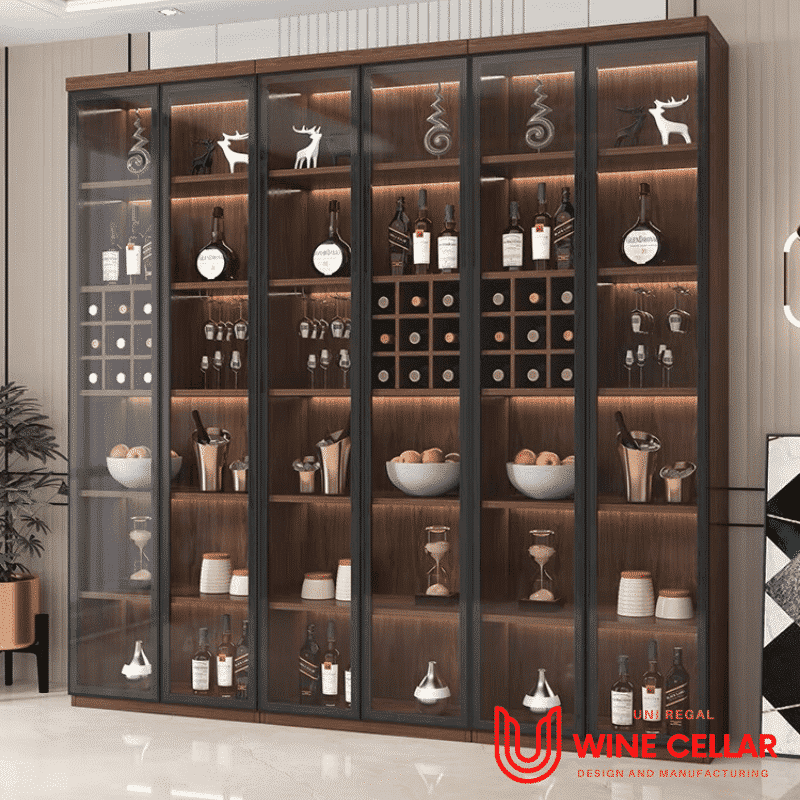
The table above has quietly produced a fourth option that deserves its own paragraph, because it is where the industry has been heading: the framed glass enclosure. Structurally it is a cellar — insulated panels behind the frame, its own sealed door, its own cooling — and visually it is furniture: metal posts, glass, the collection presented like a wall of the room. It is the answer for the buyer the table strands: the collection outgrew every cabinet, but the house has no spare room and the living space cannot give up a corner to a windowless box.
Its trade-offs are the table’s rows combined: cellar-grade cost on a cabinet-scale footprint, display visibility with real temperature control, and a failure mode that inherits the cabinet’s — one cooling system, serviceable in place if the design allows front access. The builds across our metal wine cellar work are mostly this object, drawn wall by wall at SS Wine Cellar for rooms that refused both of the table’s columns.
Where the Two Converge
The boundary between the categories is not fixed, and it is blurring from the factory side. Metal-and-glass cellar construction — the work shown across our metal wine cellar builds — behaves like furniture from the outside and like a room from the inside: a conditioned, frame-built enclosure sized to a wall rather than a cutout. It exists precisely for buyers whose collection outgrew cabinets before their building grew a spare room. If that is where your three questions landed, the design desk starts from your room’s measurements rather than from a product catalog.
The closing observation, for what it is worth from the workshop: the buyers who are happiest a year later are almost never the ones who chose the bigger object. They are the ones who split keeping from serving honestly — and let each object do only one job.
Editor’s note: this article was drafted with AI assistance and reviewed by our production and export team before publishing.
