
Why Your Stainless Quote Moves When Nickel Moves — and Why Your Freight Quote Moves When a Canal Closes
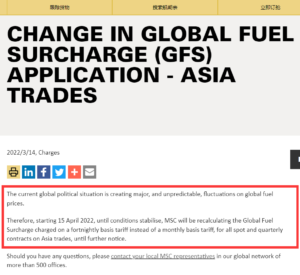
This article was first written in the spring of 2022, when two things happened in the same quarter: nickel prices spiked hard enough to halt trading on the London Metal Exchange, and the container lines announced round after round of rate increases. Buyers with quotes written in January were re-quoting in April at numbers that looked like typos. The original post was a news bulletin. This rewrite keeps the images from that period as exhibits and replaces the news with the mechanism — because the mechanism is still true, and the next spike will use it again.
Part One: How Stainless Steel Gets Its Price
Stainless steel is an alloy, and its price is dominated by two inputs: iron and nickel — with chromium and molybdenum behind them. The nickel portion is the volatile one, and it is priced on a global exchange (the London Metal Exchange is the reference for most of the industry). What that means in practice:
- The mill price is a formula, not a negotiation. Stainless mills in most markets publish a monthly or quarterly base price plus a nickel surcharge that moves with the LME. A factory buying sheet does not haggle the nickel; it inherits it.
- Grade 304 and grade 316 move differently. 316 carries molybdenum, which has its own supply swings. In some quarters, the 316 premium widens or narrows independent of nickel — which is why a quote for 304 cabinets is not a proxy for a quote for 316.
- The pass-through has a lag. A factory holding raw material stock quotes at the old price; a factory buying to order quotes at the new one. Two suppliers in the same city can honestly quote different numbers in the same week, and the difference is inventory, not honesty.
For a buyer, the practical consequence is about quotation validity. A quote valid for 30 days is a normal, honest instrument in this trade — it is the factory putting a number on how long its own inputs are predictable. A quote “valid indefinitely” from a factory that buys to order is either a stock claim or a future conversation.
Part Two: How Ocean Freight Gets Its Price
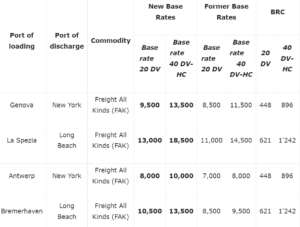
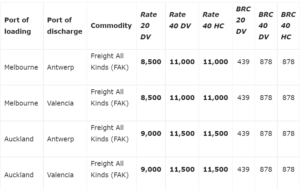
Ocean freight is priced by supply and demand for metal boxes and the ships that carry them, and the 2020–2022 period made that visible to everyone. The mechanism, stripped of news:
- Container rates are set by capacity, not distance alone. When a route loses capacity — ships repositioned, ports congested, a canal restricted — rates on that route rise even though the distance is unchanged. The 2024 diversions around the Cape of Good Hope, which added roughly ten to fourteen days to Asia–Europe voyages, did exactly this: same cargo, longer loop, fewer effective ships, higher rate.
- Spot versus contract are different products. A shipper with an annual contract rate is insulated from weekly swings; a shipper buying spot is not. Small factories and freight forwarders typically buy spot or short-term contracts, which is why their freight quotes have short validity.
- Peak season is a real season. Rates move up ahead of Western retail cycles — the pre-holiday build from late summer — and fall after. Wine coolers and cellar equipment are not holiday cargo, but they ride the same vessels.
Part Two-and-a-Half: A Worked Container Example (Illustrative Arithmetic, Not a Quote)
To make the volume logic concrete, take an illustrative cabinet: carton of 60 × 70 × 120 cm, gross weight with pallet base around 60 kg. A 20-foot container offers roughly 28 cubic meters of usable loading and about 28 tons of payload — so this cargo is volume-limited, not weight-limited. Simple stacking arithmetic: floor area per carton 0.42 m², roughly 33 cartons per layer across the container floor, two layers high within door-height limits ≈ 60–66 units per box, before dunnage and door-glass protection reduce it. The exact number for any real order comes from the packing drawing, and the honest factory will show you that drawing rather than a rounded marketing figure.
The reason this arithmetic belongs in a freight article is the decision it drives: a cabinet design that sheds 5 cm of width moves the per-layer count, which moves the per-unit freight share, which in a high-rate market can outweigh a material saving twice over. That is why packaging engineering is a real conversation at SS Wine Cellar during design rather than a warehouse afterthought — the packing drawing is part of the quotation, not an appendix to it.
Part Three: What the Buyer Should Actually Expect
Neither mechanism is a supplier’s fault, but both end up in your unit cost, so the expectations worth setting are about process:
- Expect the material and freight halves to move separately. A factory can hold a cabinet price for a quarter while its freight quote lasts a fortnight. When you compare quotes between suppliers, compare the validity windows as carefully as the numbers — a lower price with a one-week validity is not a lower price.
- Understand which Incoterm puts which price in your hands. EXW and FOB leave you buying the ocean leg, usually through your own forwarder at contract rates you may have. CIF hands the freight to the factory at its spot rate. For a buyer with a forwarder relationship, FOB plus your own freight is often the cheaper combination in a volatile market — the factory’s spot rate is a retail rate, and yours may be wholesale.
- Expect surcharge language in contracts, and read it. Raw-material escalation clauses and fuel/BAF surcharges are standard instruments, not red flags. The flag is a surcharge with no index behind it. Ask what index the clause references; “market conditions” is not an index.
- Expect weight and volume to matter more than you assumed. Wine coolers are dense freight — glass doors, compressors, steel cabinets — and they pay by whichever of weight or volume bills higher. A design change that saves 4 cm of cabinet depth can move a container’s math more than a nickel swing moves the steel.
What the 2022 Spike Actually Taught the Trade
The lasting lessons from that period are behavioral, and they are now standard practice among experienced importers: shorter quotation validity accepted as normal rather than treated as bad faith; freight booked earlier and hedged by contract rather than bought spot at shipment time; and designs re-checked for freight efficiency — because during a rate surge, the packaging engineering that fits two more cabinets per container pays back more per month than any negotiation.
The current state of both markets is, as always, temporary. The nickel formula and the container capacity logic underneath the 2022 charts are permanent, which is why this article keeps the exhibits and replaces the news. For how freight and Incoterms shape the total cost of a specific order — cabinet weights, container loading plans, EXW versus FOB arithmetic on a real quote — that conversation happens per order on our contact page, and the product-level context sits in the buying guides on our blog index.
The closing question is the one worth putting to any supplier, including us: what is the validity window on this quote, and which half of it — the steel or the sea — will expire first?
Editor’s note: this article was drafted with AI assistance and reviewed by our production and export team before publishing.
