
Eight Uses, Sorted by How Often They Actually Get Used
A smart mirror sounds like a gadget until you spend a week with one, at which point it becomes the most-used screen in the house — precisely because you were already standing in front of it. This article covers the eight uses that earn their place, ordered by how often they actually get used in a real bathroom rather than by how impressive they look in a product video. One production photo, and a note at the end on the two specifications that decide whether any of this works in a wet room.
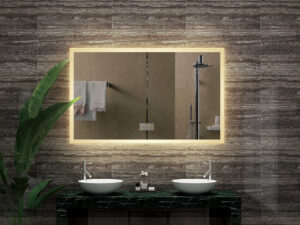
1. The Mirror That Is Never Fogged
The least glamorous feature is the most-used one: a heated demisting pad behind the glass. It warms the mirror surface a few degrees above room temperature, so shower steam never condenses on it. Before smart mirrors this existed as an after-market film; built in, it runs automatically with the mirror’s power. It is the one feature that would justify the mirror even if every screen function were switched off — ask anyone who has shaved or inserted contact lenses through a wiped porthole in the fog.
2. Light That Matches the Task
Bathroom lighting fails at the worst moment: overhead fixtures cast downward shadows across the face, and a single cool-white ceiling lamp makes everyone look ill at 6 a.m. A smart mirror integrates front-facing lighting — usually an LED halo or edge strips — with adjustable color temperature. Cool white (around 5000–6500 K) for detail work like shaving; warm white (around 2700–3000 K) for evenings; and a daylight setting in between for checking how an outfit actually looks. The brightness dial earns its place at 5:30 a.m., when full power is genuinely unpleasant.
3. The Two Minutes of Information That Matter at That Hour
Time, date, weather, and the first calendar entry of the day, displayed in a corner of the glass while you brush your teeth. This sounds trivial and is not: the morning information ritual happens in front of a mirror because that is where people already are, and moving it onto a wall screen or a phone scatters it. The best implementations keep this display dim and passive — visible at a glance, demanding nothing, and gone when the lighting is off.
4. Hands-Free Control, for the Moment Your Hands Are Full
Voice control earns its keep in a bathroom for an unglamorous reason: your hands are wet, soapy, or holding something. “Lights warmer,” “mirror, weather,” “play the news” — spoken to a microphone module integrated in the mirror, with no screen touching required. The privacy-conscious implementation processes wake-words locally and puts a physical mic switch on the unit; if a mirror’s microphone cannot be silenced with a switch, that is a fair reason to choose another one.
5. Audio While Getting Ready
Bluetooth speakers built into the mirror frame turn the bathroom into the room where the day’s first podcast or playlist happens. This is a better use of built-in audio than it sounds: bathroom acoustics are tiled and lively, and a speaker placed at head height behind glass sounds noticeably better than a waterproof box propped on a shelf. The spec that matters is not wattage but placement — and whether the speaker survives the room’s humidity, which is a sealing question, not an audio one.
6. The Television Behind the Glass
Two-way mirror glass is the trick that makes the whole category possible: half-silvered, it reflects the room normally while letting light from a panel behind it pass through. Put a display behind it and the TV is invisible until powered on — then it floats in the glass. For a long bath, this is the feature that sells the mirror; for everyone else, it is the feature that makes the mirror disappear when it is off, which is the actual design achievement. A mirror that looks like a screen all day is a worse mirror; a mirror that looks like a mirror is the point.
7. Routine Reminders That Actually Fire
Because the mirror knows the time and the person standing in front of it, it can hold the small routines that phones handle badly: medication reminders, a skincare sequence, a timer for a treatment that needs ten minutes, the school-run countdown. Displayed in the corner of the glass at the moment the person is there, these reminders work at a rate phone notifications do not approach — a notification buzzes in a pocket; a reminder is already on the wall you are facing.
8. Decluttering by Absorption
The quietest benefit is subtraction: one object replaces the clock, the radio, the bathroom TV, the task light, and often the fog-free pad that was glued behind the old mirror. Counter space in a small bathroom is scarce, and every device removed from it is a device that no longer needs cleaning, charging, or dodging the splash zone. The smart mirror’s real product is the counter it gives back.
What a Smart Mirror Should Not Claim to Do
Four honest exclusions, because the category’s marketing sometimes wanders past them. It does not diagnose health — skin-scanning features that promise dermatological readings are entertainment, not medicine, and a bathroom mirror with an agenda about your face is a worse mirror. It does not need a camera — every feature above works with a microphone at most, and a camera in the most private room of the house should be a deal-breaker rather than a feature. It does not need to be always listening — the wake-word microphone should have a physical switch, and the switch should actually cut power to the mic. And it does not need an app subscription to do the seven things that justify it; the mirror’s features should work when the vendor’s servers do not, because the fog-free glass and the front lighting are hardware, not services.
Those four exclusions are also, usefully, the questions that separate a serious manufacturer from an assembler of panels: ask how the microphone is silenced, where the camera would be, what works offline, and what the health claims are certified against. The answers sort the market quickly.
The Two Specs That Decide Whether Any of This Works
Before features, two numbers should settle the purchase, because they decide whether the mirror survives the room:
- Moisture protection. A bathroom is a wet electrical environment, and the electronics behind the glass — display, drivers, speakers, heating pad — need sealing appropriate to the zone they sit in. The rating to ask about is the IP (ingress protection) figure for the unit as installed, not for a module inside it. Ask where the power supply sits; a supply outside the wet zone is the standard safe design.
- Demisting coverage. A heating pad that covers half the glass produces a mirror that is half fogged, which is somehow worse than one that is fully fogged. The pad’s footprint should match the usable viewing area, and the honest spec is in square centimeters, not adjectives.
Everything else — voice, audio, television — is a software and module choice that can be added or ignored later. The two specs above are the reason a mirror from one factory outlives a mirror from another.
This mirror work sits alongside our wine storage engineering on the same production floor — the shared skill is glass and humidity control, and the design desk handles both. For the wine-facing side of that trade, the guides on our blog index cover storage, coolers, and cellars.
And the closing observation from use rather than from marketing: the feature everyone asks about is the television behind the glass, and the feature nobody stops using is the one that keeps the mirror clear. Buy for the second; enjoy the first.
Editor’s note: this article was drafted with AI assistance and reviewed by our production and export team before publishing.
