
Six Real Storage Situations, Two Materials, One Verdict Each
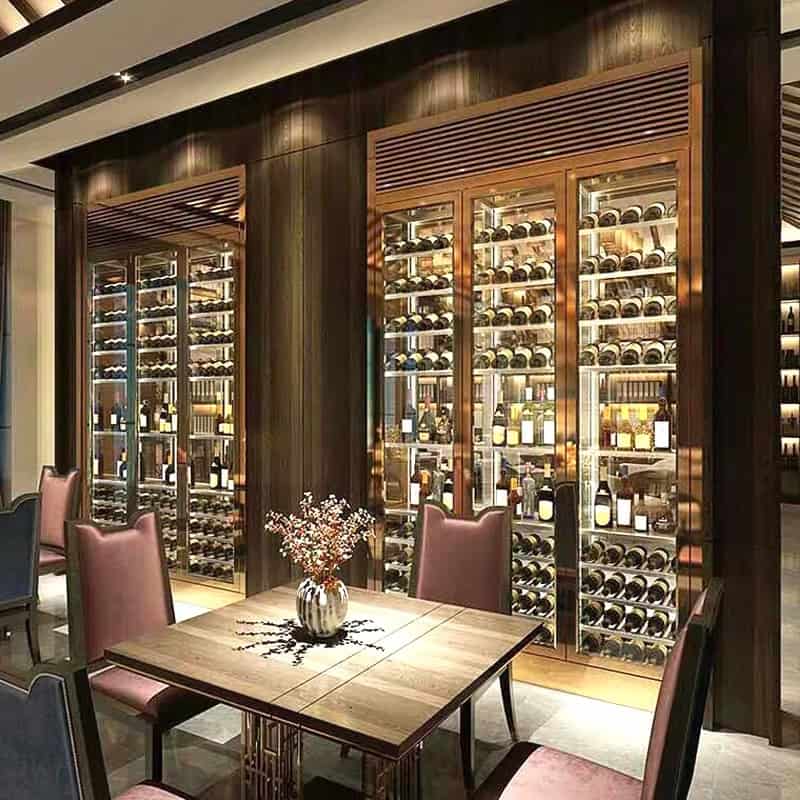
Wooden versus metal wine storage is usually argued on taste, which is why the argument never resolves. Both materials have held wine for centuries, both fail in specific conditions, and the correct answer changes from project to project. So this comparison is written as six real storage situations — the ones that actually arrive at a factory’s inbox — with a verdict and a reason for each. The general physics is at the end, for those who want it, and the photo of a metal build sits where the argument turns on humidity.
Situation One: The Long-Term Keeping Cellar
Verdict: either, with one check. Wine does not care what it rests on; it cares that the room holds about 13°C steadily and 60–70% relative humidity. Wood racking (mahogany, redwood, and other rot-resistant species are the traditional choices) and metal racking both hold bottles horizontally and do not interact with the wine through the glass. The check is the room’s humidity: at the wet end of the band, wood composites and low-density species swell and grow mold at the joints; metal ignores it. At the dry end, neither material matters and the corks do.
Situation Two: The Coastal or Poolside Home
Verdict: metal, and it must be the right metal. Salt-laden air is the aggressive enemy of both materials: it rots wood finishes and attacks standard stainless. Grade 304 stainless handles indoor humidity well but is not chloride-proof; grade 316, with its added molybdenum, is the specification for coastal exposure. A wood cellar near the ocean is a maintenance commitment in a way that a 316 cellar is not.
Situation Three: The Dining Room Display
Verdict: metal, usually, for structural reasons. Display storage wants thin sightlines, long spans, and precise pitch — angled shelves, label-forward presentation, integrated lighting. Wood achieves display beautifully in traditional joinery, but it cannot do thin: a wood shelf presenting bottles at an angle needs visible thickness to carry the load, while a steel rail frame can hold a row on a sightline a few millimeters wide. If the room’s style is traditional and the wood matches the joinery, wood wins on aesthetics; if the room is modern or the spans are long, metal wins on physics.
Situation Four: The Humid Basement
Verdict: metal, strongly. This is the clearest case in the set. A basement at the top of the humidity band grows mold on organic materials, swells wood joints until racks bind, and eventually rots any finish. Stainless steel neither feeds mold nor moves with moisture — it wipes clean and stays dimensionally true. The one caveat belongs to the steel, not the wood: in a genuinely damp room, the corrosion risk is the fittings and fasteners, so specify stainless hardware throughout rather than plated screws on stainless rails.
Situation Five: The Budget Project or Rental Fit-Out
Verdict: wood, on economics. Where the goal is adequate storage at minimum cost, timber racking from a joinery shop or a flat-pack system is usually cheaper per bottle than fabricated metal, and it can be repaired by any carpenter. The honest cost accounting includes what the material cannot do: no tight display pitch, no tall bays without custom joinery, and a shorter service life in damp rooms. For a cellar whose job is simply to hold bottles horizontally in a steady room, wood spends less to do it.
Situation Six: The Commercial Program — Restaurants, Hotels, Retail
Verdict: metal, for operational reasons. Commercial storage gets wiped down, bumped by trolleys, relit, and reconfigured. Stainless steel survives all four: it is non-porous and hygienic, it tolerates cleaning chemicals, and modular metal racking re-pitches when the wine list changes. Wood’s virtues — warmth, traditional look — remain real in a hotel lobby cellar, but the back-of-house storage that staff actually use is a metal decision almost everywhere.
Situation Seven: The Mixed Marriage — Wood Furniture, Metal Racks
The most common real answer is neither pure wood nor pure metal. A traditional dining room wants a wood cabinet or joinery; the back room wants modular steel. This works, with one boundary rule: keep the two materials in different thermal zones. Wood furniture standing in a conditioned cellar room lives in damp air it was never built for — its finish lifts, its joints creep. Metal racking standing in a dry dining room is perfectly happy, but its polished faces show fingerprints next to warm timber in a way photographs never predict.
The clean split, and the one we build most often at SS Wine Cellar: wood where the room is dry and the style is traditional, metal wherever the air is conditioned, damp, or the spans are long. The join between the two — a glazed door, a finish transition, a bulkhead — is the detail worth engineering rather than improvising, because it is where the two materials’ different movement rates meet.
The Physics, For Those Who Want It
What wood does well: it is warm to the touch and visually forgiving; it does not conduct cold onto the bottle contact line the way bare steel can; and traditional species carry no strong aroma once properly dried. What wood does badly: it is organic — it moves with humidity, feeds mold, holds odors (which is why strongly aromatic species like cedar are avoided near wine despite their rot resistance), and it burns.
What metal does well: it is inert, dimensionally stable, hygienic, and it holds tolerances a sawdust shop cannot — which is why re-pitchable racking and mixed-format bays are metal problems solved easily and wood problems solved expensively. What metal does badly: it conducts (a minor issue on contact lines, solved by rail design), it shows fingerprints on polished surfaces, and it demands real engineering — a metal cellar that is not drawn against the room’s measurements is a box of expensive parts.
Neither material interacts with the wine itself through glass and cork. The bottle does not know what it lies on; the room decides almost everything.
Maintenance, Compared Honestly
The two materials also age differently under care, which belongs in the decision. Wood wants an occasional check of joints and finish, and it cannot be power-washed or disinfected aggressively — its surface is the finish. Metal tolerates far harsher cleaning, which is why commercial kitchens specify it, but its failure modes are quieter: a scratched polished panel stays scratched, a chipped coating on a spray-finished rail invites corrosion at the edge, and plated fasteners on stainless rails rust long before the rails do. In both cases the annual cost of ownership is minutes, not hours — the real difference is what kind of damage is repairable. Wood repairs locally with sandpaper and oil; metal repairs by replacing the panel. That trade favors wood for small scuffs and metal for structural honesty: when a metal rack looks sound, it is sound.
The One Question That Decides It
Strip the six situations and one question remains: what does the room’s humidity and air actually do? Steady, dry, inland: either material, so choose by style and budget. Damp, coastal, commercial: metal, with the alloy specified for the exposure. That single measurement — two weeks of hygrometer readings — sorts more wood-versus-metal arguments than any catalog, and it is free.
Where the answer is metal and the room is not a standard rectangle, the built-to-order route is our design desk’s daily work, and the finished rooms across our metal cellar builds show how the material behaves when the drawing comes from measurements rather than assumptions. For the wood side of the decision, the racking-geometry guides on our blog index apply to both materials equally.
And the closing note from the workshop floor: buyers rarely regret the material they chose for the right reason. They regret choosing a material for its photo — in a room the material was never asked to survive.
Editor’s note: this article was drafted with AI assistance and reviewed by our production and export team before publishing.

4 Responses
I have to thank you for the efforts youve put in writing this website. Im hoping to see the same high-grade content from you in the future as well. In fact, your creative writing abilities has encouraged me to get my very own website now 😉
Yes, you should do what you think and keep trying. God Bless You.
Itís hard to find knowledgeable people for this subject, but you seem like you know what youíre talking about! Thanks
Thanks for your kind words, we will try to make more useful content for you guys.